
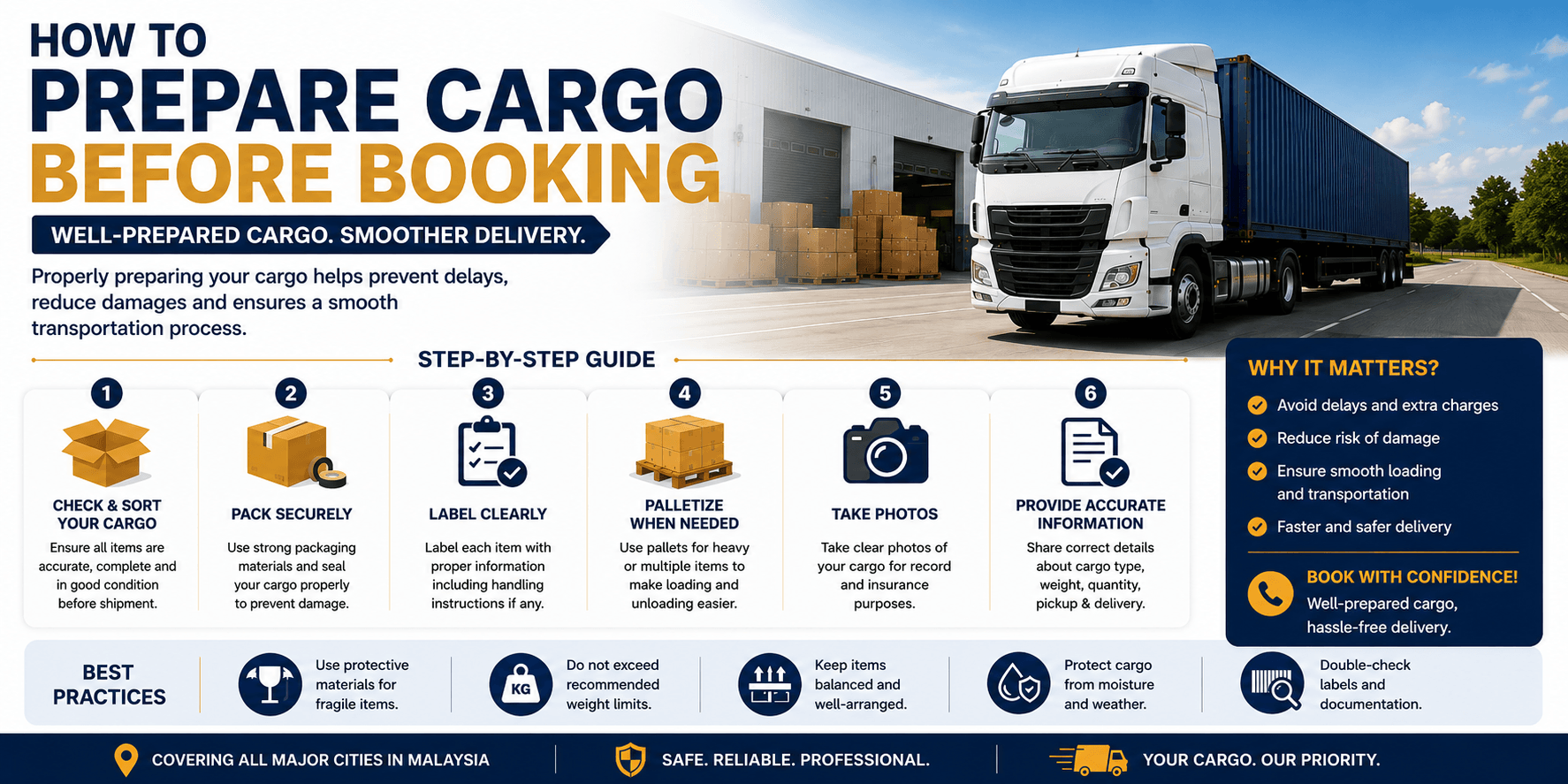
Businesses that transport commercial goods regularly understand that successful freight movement begins long before a vehicle arrives for collection. A well-planned cargo transportation guide helps businesses prepare shipments correctly, minimise operational delays and reduce the risk of damage during transit.
Whether transporting goods between warehouses, manufacturing facilities, distribution centres or retail outlets, proper cargo preparation allows logistics providers to coordinate transportation more efficiently. Accurate shipment information, secure packaging and organised loading arrangements all contribute to smoother freight operations across Malaysia.
Rather than viewing cargo preparation as a final task before collection, businesses should treat it as an important part of supply chain management. Following a structured cargo transportation guide helps improve loading efficiency, supports reliable delivery schedules and ensures shipments are ready for safe transportation.
Why Following a Cargo Transportation Guide Matters
Preparing cargo correctly benefits both businesses and logistics providers. When shipments are properly measured, packaged and organised before collection, transportation can be planned more accurately, helping reduce avoidable disruptions throughout the delivery process.
Businesses that follow a structured cargo transportation guide can benefit from:
- More efficient loading and unloading
- Better vehicle allocation
- Reduced risk of cargo damage
- Improved delivery coordination
- Fewer transportation delays
- Better overall supply chain efficiency
For businesses arranging recurring commercial freight, consistent preparation also supports smoother warehouse operations and more reliable inventory movement.
Step 1: Measure Cargo Accurately
Accurate cargo measurements are one of the most important parts of any cargo transportation guide. Incorrect shipment information can affect vehicle selection, loading capacity and transportation planning.
Before arranging transport, businesses should confirm:
- Cargo dimensions (length, width and height)
- Total cargo weight
- Number of pallets or packages
- Overall shipment volume
Providing accurate measurements enables logistics providers to recommend suitable vehicles and coordinate freight more efficiently while helping businesses avoid unnecessary operational delays.
Step 2: Use Suitable Packaging
Packaging plays an important role in protecting commercial goods throughout transportation. Cargo should always be packed according to its size, weight and handling requirements to minimise movement during transit.
Depending on the shipment, suitable packaging may include:
- Corrugated cartons
- Wooden crates
- Stretch wrapping
- Protective cushioning
- Edge protectors
- Industrial packaging materials
Strong, secure packaging helps protect cargo throughout loading, transportation and unloading while reducing the likelihood of damage.
Step 3: Prepare Pallets Correctly
Many commercial shipments are transported on pallets because they improve handling efficiency and loading safety.
Businesses should ensure that:
- Cargo is evenly distributed.
- Goods do not extend beyond pallet edges.
- Pallets are securely wrapped.
- Loose items are properly secured.
- Damaged pallets are replaced before collection.
Proper pallet preparation makes loading safer while improving stability throughout transportation.
Step 4: Label Every Shipment Clearly
Every shipment should be clearly labelled before collection to reduce handling errors and improve identification during transportation.
Labels should include:
- Company name
- Delivery destination
- Shipment reference number (if applicable)
- Number of packages
- Handling instructions where required
Fragile, oversized or specialised cargo should also display appropriate handling labels so logistics personnel can manage shipments accordingly.
Step 5: Prepare the Collection Area
An effective cargo transportation guide extends beyond preparing the goods themselves. Businesses should also ensure that the pickup location is ready before the transport vehicle arrives.
Before collection:
- Prepare the loading area.
- Ensure cargo is completely packed.
- Confirm loading equipment is available if required.
- Remove access obstacles.
- Notify warehouse personnel of the scheduled collection.
Proper site preparation helps reduce loading delays and allows freight to move more efficiently from collection to delivery.
Step 6: Prepare Complete Shipment Information
A successful cargo transportation guide includes providing complete shipment information before transportation begins. Accurate details allow logistics providers to plan vehicle allocation, loading arrangements and delivery schedules more efficiently while reducing the risk of unnecessary delays.
Before booking transportation, businesses should prepare:
- Pickup location
- Delivery destination
- Cargo dimensions
- Cargo weight
- Number of pallets or packages
- Preferred pickup date and time
- Site contact person
- Special handling requirements (if applicable)
Providing complete shipment information enables logistics providers to recommend the most suitable transportation solution while improving overall freight coordination.
Step 7: Communicate Special Cargo Requirements
Not every shipment can be transported using standard handling procedures. Certain types of commercial freight require additional planning to ensure they are transported safely and efficiently.
Businesses should inform their logistics provider if the cargo is:
- Fragile
- Oversized
- Heavy machinery or industrial equipment
- High-value goods
- Stackable or non-stackable
- Time-sensitive
- Temperature-sensitive (where applicable)
Sharing these requirements before collection allows appropriate vehicles, equipment and handling procedures to be arranged in advance.
Common Cargo Preparation Mistakes
Even experienced businesses can overlook important details before arranging transportation. Avoiding these common mistakes helps improve delivery efficiency while reducing operational disruptions.
Some of the most common mistakes include:
- Providing inaccurate cargo dimensions or weight
- Using damaged pallets
- Insufficient packaging protection
- Missing or unclear shipment labels
- Not declaring fragile or oversized cargo
- Incomplete pickup or delivery information
- Failing to prepare the loading area before collection
Reviewing cargo carefully before booking helps businesses minimise delays and allows transportation to proceed more smoothly.
Cargo Transportation Checklist
Before arranging commercial freight transportation, use this simple cargo transportation guide checklist:
- Measure cargo dimensions accurately
- Confirm total shipment weight
- Securely package all goods
- Wrap and stabilise pallets
- Label every shipment clearly
- Verify pickup and delivery addresses
- Prepare the loading area
- Arrange loading equipment if required
- Communicate any special handling requirements
- Confirm contact personnel at both pickup and delivery locations
Following this checklist helps businesses improve shipment readiness while enabling logistics providers to coordinate transportation more efficiently.
Best Practices for Business Cargo Transportation
Businesses that move commercial freight regularly can further improve transportation efficiency by adopting consistent cargo preparation procedures.
Some recommended best practices include:
- Standardise packaging methods across all shipments.
- Maintain accurate records of cargo dimensions and weight.
- Inspect goods before every collection.
- Schedule shipments in advance whenever possible.
- Keep warehouse teams informed of collection times.
- Review transport requirements before requesting quotations.
- Work with an experienced logistics provider familiar with commercial freight.
A structured cargo preparation process supports smoother operations, reduces unnecessary disruptions and contributes to more reliable supply chain performance.
How J&G Global Logistics Supports Business Cargo Transportation
J&G Global Logistics assists manufacturers, distributors, wholesalers, retailers and warehouse operators by helping businesses prepare commercial freight before transportation begins. Through organised shipment planning, practical logistics coordination and clear communication, the company helps ensure cargo is ready for safe and efficient transport.
Whether transporting goods within Peninsular Malaysia or coordinating cross-border freight, J&G Global Logistics works closely with businesses to recommend suitable transportation solutions based on cargo requirements, delivery schedules and operational priorities.
Following a structured cargo transportation guide helps businesses reduce avoidable delays, improve freight efficiency and support long-term supply chain performance.
Need help preparing your cargo for transport? Contact J&G Global Logistics today to discuss your shipment requirements and receive professional guidance before your next commercial freight movement.
Frequently Asked Questions
A cargo transportation guide helps businesses prepare freight before transport by covering packaging, cargo measurements, labelling and shipment information. Following a structured preparation process reduces delays, improves handling efficiency and supports smoother commercial freight operations.
Proper cargo preparation allows logistics providers to plan transportation more accurately while reducing the risk of damaged goods, loading delays and vehicle allocation issues. Well-prepared shipments improve overall freight efficiency.
Businesses should provide pickup and delivery locations, cargo dimensions, shipment weight, number of pallets or packages, preferred collection schedule and any special handling requirements. Accurate information supports better transport planning.
Commercial cargo should be securely packaged using materials suitable for its size, weight and handling requirements. Strong packaging helps protect goods during loading, transportation and unloading.
Accurate cargo dimensions allow logistics providers to recommend suitable vehicles, allocate loading space efficiently and avoid transportation delays caused by incorrect shipment information.
Common mistakes include inaccurate cargo measurements, poor packaging, damaged pallets, incomplete shipment information and failing to communicate special handling requirements before transportation.
Yes. J&G Global Logistics helps businesses prepare commercial freight by reviewing shipment requirements, recommending suitable transportation solutions and coordinating efficient cargo movement across Malaysia and selected cross-border routes.