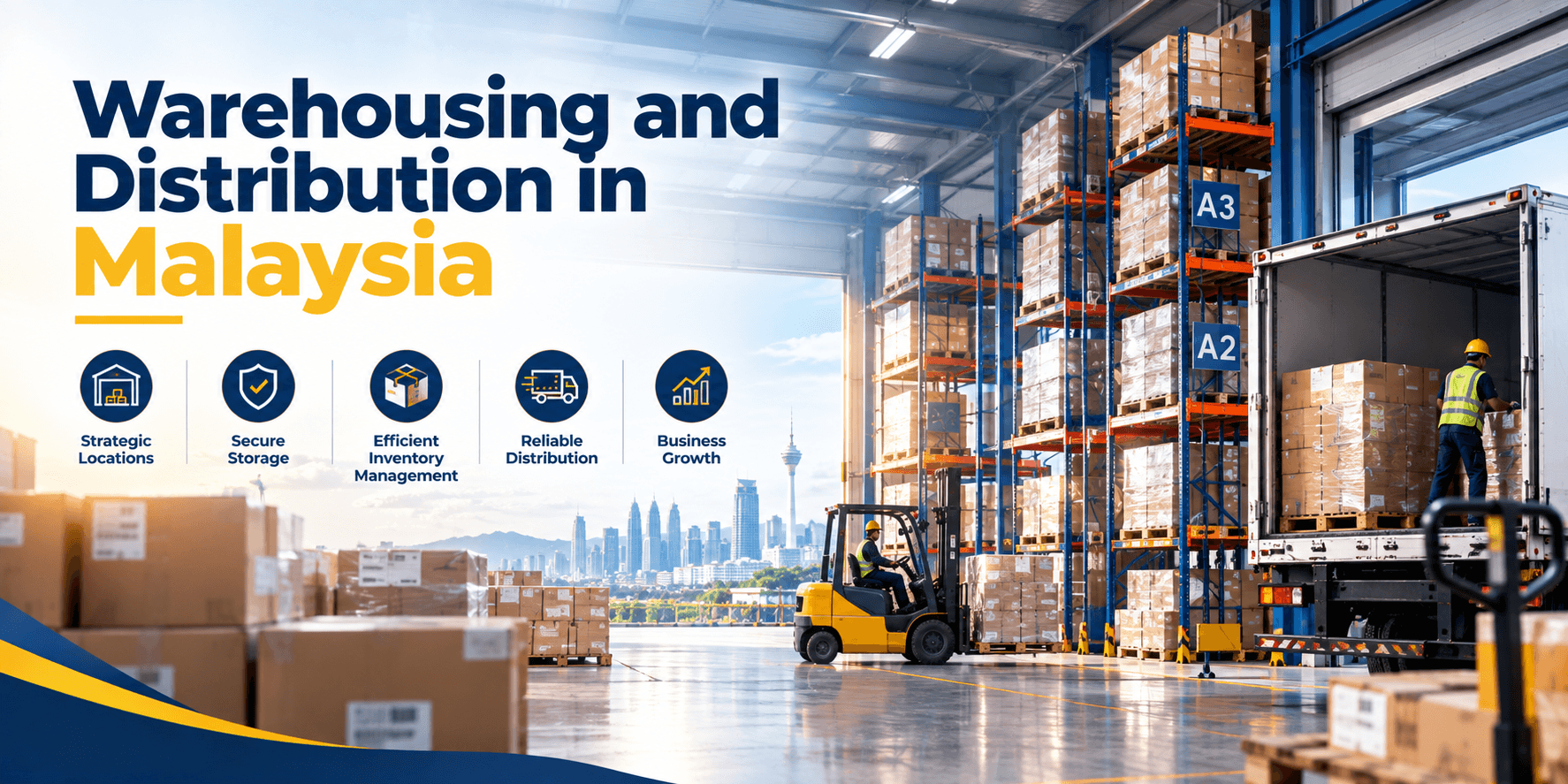
Businesses that store, manage and distribute commercial goods need more than physical storage space. Effective warehousing and distribution can help businesses organise inventory, manage orders and coordinate the movement of goods between suppliers, warehouses and customers.
For businesses looking for warehousing and distribution in Malaysia, understanding how storage, fulfilment and transportation work together can make logistics planning easier.
What Is Warehousing and Distribution?
Warehousing involves storing goods at a designated facility before they are needed for production, sale or distribution.
Distribution is the process of moving goods from a warehouse or other storage location to their intended destination.
Together, warehousing and distribution can form an important part of a business supply chain.
A typical process may look like:
Supplier → Transportation → Warehouse → Storage → Order Fulfilment → Distribution → Customer
The exact process depends on the type of goods, inventory requirements, order volumes and distribution locations.
How Does Warehousing and Distribution Work?
A typical warehousing and distribution process can involve several stages.
Receiving Goods
Goods arrive at the warehouse from suppliers, manufacturers, ports or other locations.
The receiving process may involve checking shipment information, quantities, packaging and other relevant details.
Storage
After receiving the goods, products are placed in suitable storage areas.
The storage arrangement can depend on factors such as product type, size, quantity and handling requirements.
Inventory Management
Businesses need to keep track of goods stored in the warehouse.
Accurate inventory information can help businesses understand available stock and plan replenishment or distribution.
Order Fulfilment
When an order is received, the required products can be prepared for dispatch.
Depending on the warehouse arrangement, fulfilment may include picking, packing and labelling.
Distribution and Delivery
After receiving an order, warehouse staff prepare the required products for dispatch.
Transportation may involve road, sea or air freight depending on the shipment requirements.
What Do Warehousing Services in Malaysia Include?
Warehousing services can vary between providers and facilities.
Depending on the business and service arrangement, warehousing may include:
- Commercial storage
- Short-term storage
- Long-term inventory storage
- Receiving and dispatching
- Inventory handling
- Pick and pack services
- Labelling
- Order fulfilment
- Container handling
- Distribution coordination
- Transportation support
Businesses should confirm exactly which services are included before selecting a warehouse provider.
What Should Businesses Consider When Choosing a Warehouse?
Choosing a suitable warehouse involves more than comparing available storage space.
Warehouse Location
Location can affect transportation requirements and delivery planning.
Businesses should consider where suppliers, customers, ports and other important logistics points are located.
A warehouse positioned appropriately within the supply chain can help simplify transportation planning.
Storage Requirements
Businesses should consider the amount and type of inventory they need to store.
Important information can include:
- Product type
- Number of units
- Storage volume
- Dimensions
- Expected inventory levels
- Storage duration
- Handling requirements
Accessibility
Businesses should consider how easily goods can move into and out of the warehouse.
Businesses may need particularly accessible facilities when they regularly receive or distribute inventory.
Inventory Requirements
Businesses should understand how inventory will be recorded, monitored and managed.
Clear inventory processes can help reduce confusion when goods are received, stored, picked and dispatched.
Order Fulfilment
For businesses selling or distributing products, fulfilment can be an important consideration.
Services such as picking, packing and labelling can help prepare orders before they are transported to customers.
Transportation and Distribution
Warehousing is often connected to transportation.
Businesses should consider how goods will move between suppliers, warehouses and final destinations.
This can include local trucking, domestic transportation, cross-border transportation, sea freight or air freight depending on the shipment.
What Is the Difference Between Warehousing and Distribution?
Warehousing primarily focuses on storing and managing goods, while distribution focuses on moving goods to their intended destinations.
For example:
Warehousing:
Supplier → Receiving → Storage → Inventory
Distribution:
Warehouse → Order Preparation → Transportation → Customer
In practice, businesses may use both services as part of one logistics process.
How Much Do Warehousing and Distribution Services Cost?
There is no single fixed price for warehousing and distribution services in Malaysia.
The total cost can depend on several factors, including:
- Amount of storage space required
- Type of goods
- Storage duration
- Inventory volume
- Order fulfilment requirements
- Pick and pack requirements
- Container handling
- Transportation distance
- Delivery locations
- Frequency of distribution
- Special handling requirements
Businesses should provide accurate information about their inventory and distribution requirements when requesting a quotation.
When Should a Business Use Third-Party Warehousing?
Businesses may consider third-party warehousing when they need additional storage or logistics support without managing every warehouse operation themselves.
This may be useful when:
- Inventory levels fluctuate
- Additional storage space is required
- A business is expanding into new markets
- Order fulfilment needs to be outsourced
- Import or export goods require storage
- Businesses want to coordinate storage with transportation
The appropriate arrangement depends on the business’s inventory and logistics requirements.
Warehousing and Distribution for Import and Export
Warehousing can also form part of international supply chains.
Imported goods may need to move through several stages before reaching their final destination, while exported goods may require storage and preparation before transportation.
A simplified process could be:
Supplier → Transportation → Warehouse → Order Preparation → Export Transportation → Destination
Businesses should consider documentation, customs requirements, cargo characteristics and transportation arrangements when planning international shipments.
How Warehousing Connects With Other Logistics Services
Warehousing rarely operates independently from the rest of the supply chain.
A business may require several services to move goods efficiently:
Supplier → Trucking → Warehouse → Storage → Air/Sea Freight → Destination → Delivery
For example, road transportation may move cargo to a warehouse, while sea or air freight may transport it internationally.
Coordinating these services can help businesses manage shipments involving multiple logistics stages.
Commercial Warehousing in Malaysia
Commercial warehousing can support businesses that need space for inventory storage, order fulfilment and distribution activities.
Depending on the warehouse and service arrangement, businesses may require:
- Short-term storage
- Long-term inventory positioning
- Bonded or non-bonded storage
- Pick, pack and label services
- Container stuffing and de-stuffing
- Transportation coordination
- Distribution support
Businesses should discuss their specific storage and logistics requirements with the provider before selecting a solution.
J&G Global Logistics Warehousing Services
J&G Global Logistics provides warehousing services as part of its logistics solutions.
Its warehousing service information covers flexible storage solutions for short-term overflow and longer-term inventory positioning, with locations referenced around JB, KL and Selangor.
The service also includes bonded and non-bonded warehousing for import, export and cross-border requirements.
For businesses requiring fulfilment support, the service includes pick, pack and label activities. Container handling is also available for full-container stuffing and de-stuffing, with onward movement by sea, air or road.
J&G also connects its warehousing services with transportation and freight services, allowing businesses to discuss storage alongside their wider logistics requirements.
How to Choose Warehousing and Distribution Services in Malaysia
Before selecting a provider, businesses should prepare information about their requirements.
Consider:
- Type of goods
- Inventory quantity
- Required storage space
- Expected storage duration
- Pickup location
- Delivery locations
- Order frequency
- Fulfilment requirements
- Container requirements
- Transportation requirements
- Any special handling needs
Providing accurate information can help the logistics provider understand the requirement and prepare a more suitable quotation.
Warehousing and Distribution Checklist
Before arranging commercial warehousing, businesses should confirm:
- What goods need to be stored?
- How much inventory needs to be stored?
- How long will the goods remain in storage?
- Where are the goods coming from?
- Where will the goods eventually be delivered?
- Is order fulfilment required?
- Are pick, pack or labelling services required?
- Is container handling required?
- Is transportation required?
- Are there any special cargo requirements?
Having these details ready can make discussions with a warehouse provider more efficient.
Request a Warehousing and Distribution Quote in Malaysia
If you’re looking for warehousing and distribution in Malaysia, J&G Global Logistics provides warehousing solutions to support businesses with storage, order fulfilment, container handling, and wider logistics requirements. Request a quote today to discuss your storage and distribution needs.
Frequently Asked Questions
Warehousing involves storing and managing goods, while distribution involves moving those goods from a warehouse or other location to their intended destination.
Depending on the provider, warehousing services may include storage, receiving, inventory handling, order fulfilment, picking, packing, labelling and container handling.
The cost can depend on storage space, inventory volume, storage duration, fulfilment requirements, handling needs, transportation and other logistics requirements.
Warehousing focuses mainly on storing and managing inventory, while distribution focuses on preparing and transporting goods to their destinations.
Yes. Warehousing can form part of import and export logistics, depending on the cargo, documentation, customs requirements and storage arrangement.
Warehousing provides a location where goods can be received, stored, prepared and dispatched before being transported to customers or other destinations.
Consider the warehouse location, storage requirements, inventory volume, fulfilment needs, handling requirements, transportation options and overall logistics requirements before selecting a service.