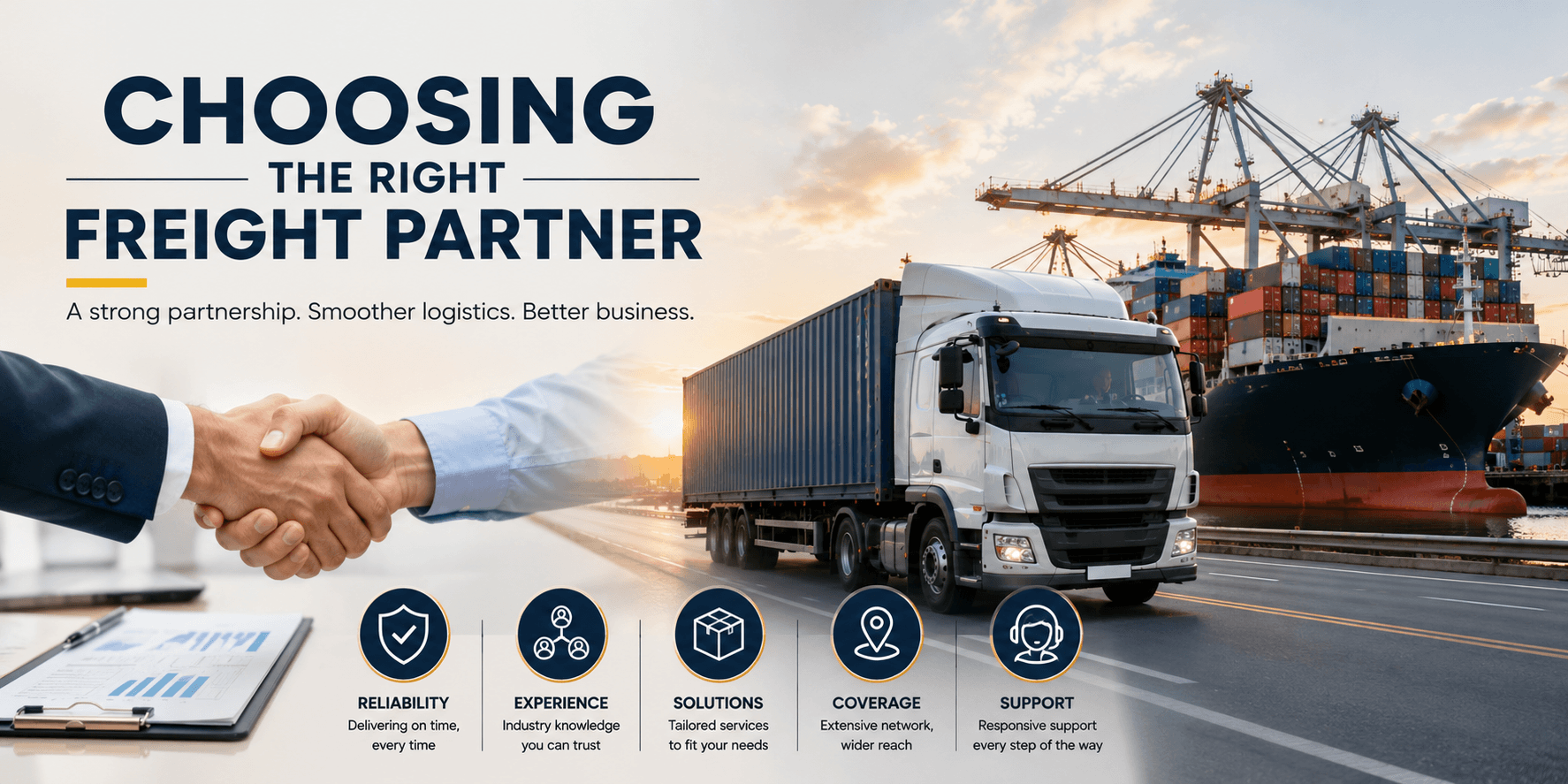
Choosing the right freight partner is one of the most important decisions a business can make when managing its supply chain. Whether transporting goods across Peninsular Malaysia, coordinating warehouse deliveries or arranging cross-border shipments, the right logistics provider can help improve operational efficiency, reduce transportation challenges and support long-term business growth.
Many businesses compare logistics providers based primarily on freight rates. While transportation costs are an important consideration, selecting a freight partner involves evaluating much more than price alone. Service reliability, transportation capabilities, communication standards and industry experience all contribute to efficient freight movement and dependable supply chain performance.
An experienced logistics company in Malaysia does more than move cargo from one location to another. It helps businesses plan shipments, coordinate transportation, recommend suitable logistics solutions and support ongoing commercial operations. Whether you are a manufacturer, distributor, wholesaler, retailer or warehouse operator, partnering with the right freight provider allows your business to manage inventory more efficiently while maintaining consistent delivery performance.
This guide explains the key factors businesses should consider when choosing a freight partner, helping decision-makers identify a logistics provider that can support both immediate transportation requirements and future operational growth.
Why Choosing the Right Freight Partner Matters
Freight transportation plays an essential role in every commercial supply chain. Raw materials need to arrive before production begins, finished goods must reach warehouses on schedule and inventory has to be delivered efficiently to customers and distribution centres.
Choosing the wrong logistics provider can lead to delayed deliveries, poor communication, unsuitable transport arrangements and unnecessary operational costs. Over time, these issues can affect inventory availability, customer satisfaction and overall business performance.
Working with a dependable freight partner helps businesses:
- Improve supply chain coordination
- Maintain reliable delivery schedules
- Reduce transportation disruptions
- Improve inventory management
- Support recurring commercial freight movement
- Increase operational efficiency
- Build long-term logistics stability
Rather than simply providing transportation, an experienced freight partner becomes an extension of your supply chain by helping businesses plan freight movement more effectively.
1. Evaluate Industry Experience
Not every logistics provider has experience supporting commercial freight operations. Before selecting a freight partner, businesses should assess whether the provider regularly works with organisations that have similar logistics requirements.
Different industries require different transportation solutions. Manufacturers often need recurring deliveries of production materials, while wholesalers manage inventory distribution across multiple locations. Retailers require dependable stock replenishment, and warehouse operators coordinate frequent transfers between storage facilities and customers.
A freight partner with commercial logistics experience is generally better equipped to understand:
- Manufacturing supply chains
- Warehouse operations
- Distribution networks
- Retail inventory movement
- Commercial freight scheduling
- Business-to-business transportation
Industry knowledge enables logistics providers to recommend practical transportation solutions that align with operational requirements rather than offering a one-size-fits-all service.
2. Assess the Range of Logistics Services
Business logistics requirements often evolve over time. A company may initially require domestic transportation but later expand into cross-border shipping, warehousing or international freight.
Choosing a freight partner that offers multiple logistics solutions allows businesses to work with a single provider as their operations grow.
Businesses should consider whether the provider offers:
- Domestic transportation
- Cross-border transportation
- Sea freight
- Air freight
- Warehousing
- Commercial freight coordination
- Scheduled recurring deliveries
Working with a provider that supports multiple logistics services creates greater flexibility while reducing the complexity of managing several transport vendors.
3. Review Transportation Coverage
A freight partner should have the operational capability to support both your current transportation needs and future expansion plans.
Businesses operating across Malaysia should confirm that the provider serves key commercial and industrial regions, including:
- Johor Bahru
- Kuala Lumpur
- Selangor
- Penang
- Melaka
- Negeri Sembilan
- Perak
If regional trade is part of your operations, the provider should also have experience coordinating JB to Singapore freight and other cross-border transportation requirements.
Choosing a logistics company with broad route coverage helps businesses maintain consistent freight movement while reducing the need to engage multiple providers.
4. Understand Their Commercial Freight Capabilities
Commercial freight requires more planning than standard parcel deliveries. Businesses should evaluate whether the logistics provider regularly manages large-volume shipments, palletised cargo and recurring transportation for commercial operations.
An experienced freight partner should be able to support:
- Manufacturing logistics
- Warehouse replenishment
- Distribution centre deliveries
- Retail inventory transportation
- Industrial equipment movement
- Business-to-business freight
- Scheduled commercial deliveries
Understanding a provider’s freight capabilities helps businesses determine whether the logistics company can support both day-to-day transportation and long-term operational requirements.
5. Assess Communication and Customer Support
Clear communication is one of the most important characteristics of a reliable freight partner. Even well-planned shipments can experience changes, making responsive communication essential throughout the transportation process.
Businesses should expect:
- Prompt responses to enquiries
- Clear freight quotations
- Accurate shipment confirmations
- Reliable pickup coordination
- Delivery updates where appropriate
- Responsive customer support
A logistics provider that communicates proactively helps businesses manage transportation more confidently while reducing misunderstandings that can affect delivery performance.
6. Choose a Freight Partner That Can Grow With Your Business
As businesses expand, transportation requirements often become more complex. Shipment volumes increase, delivery destinations grow and additional logistics services may become necessary.
Before selecting a freight partner, businesses should consider whether the provider can support:
- Increased shipment frequency
- Higher freight volumes
- Additional delivery locations
- Cross-border expansion
- Warehousing requirements
- Seasonal demand fluctuations
- Long-term logistics planning
Choosing a scalable logistics partner reduces the need to switch providers as your business grows, helping maintain consistency across your supply chain.
7. Evaluate Pricing Transparency
While freight pricing is an important consideration, businesses should avoid selecting a logistics provider based solely on the lowest quotation. A lower price does not always represent better value if essential services or operational support are excluded.
Before accepting a quotation, businesses should understand exactly what is included in the service.
Questions to ask include:
- Is the recommended vehicle suitable for the shipment?
- Are loading or unloading services included?
- Does the quotation include waiting time if required?
- Are there additional charges for special handling?
- Are recurring freight arrangements available?
A transparent quotation helps businesses compare logistics providers more accurately while reducing the likelihood of unexpected costs after transportation has been arranged.
8. Consider Operational Reliability
A dependable freight partner should consistently deliver on agreed schedules while maintaining organised transportation planning. Reliability becomes especially important for businesses managing recurring freight movements, manufacturing operations or time-sensitive inventory.
When evaluating a logistics provider, businesses should consider:
- Consistency of pickup and delivery schedules
- Ability to manage recurring shipments
- Flexibility when operational requirements change
- Coordination between transportation and warehouse operations
- Clear communication throughout the freight process
Reliable logistics support contributes to smoother business operations and helps minimise unnecessary supply chain disruptions.
9. Look for Long-Term Partnership Potential
Many businesses initially engage a logistics provider for a single shipment but later require additional transportation services as operations expand. Rather than changing providers each time logistics requirements evolve, it is often more efficient to build a long-term relationship with a freight partner that understands the business.
A long-term freight partner can support:
- Business growth
- Expanding delivery networks
- New warehouse locations
- Cross-border transportation
- Increasing shipment volumes
- Seasonal freight demand
Building an ongoing partnership also allows logistics providers to better understand operational priorities, enabling more efficient freight planning over time.
10. Watch for Common Red Flags
Choosing the wrong freight partner can create unnecessary operational challenges. Before committing to a logistics provider, businesses should watch for warning signs that may indicate poor service quality or limited operational capability.
Some common red flags include:
- Unclear or incomplete freight quotations
- Poor communication before booking
- Limited transportation coverage
- Lack of experience with commercial freight
- Inability to explain recommended transport solutions
- No flexibility for changing shipment requirements
- Slow response to customer enquiries
Identifying these issues early helps businesses avoid transportation problems that may affect future operations.
Freight Partner Evaluation Checklist
Before selecting a freight partner, businesses can use the following checklist to compare different logistics providers objectively.
- Experience supporting commercial freight
- Domestic transportation capabilities
- Cross-border transportation services
- Warehousing solutions (if required)
- Broad transportation coverage
- Clear and transparent quotations
- Reliable customer communication
- Flexible logistics solutions
- Ability to support business growth
- Strong reputation for commercial logistics
Using a structured evaluation process helps businesses select a logistics provider that aligns with both current operational needs and long-term supply chain objectives.
Why Businesses Choose J&G Global Logistics
J&G Global Logistics supports manufacturers, distributors, wholesalers, retailers and warehouse operators with dependable commercial logistics solutions across Malaysia. By combining domestic transportation, cross-border freight, sea freight, air freight and warehousing services, the company provides businesses with practical logistics support tailored to their operational requirements.
Rather than offering a one-size-fits-all approach, every shipment is planned according to cargo characteristics, delivery schedules and business priorities. This enables customers to manage freight more efficiently while maintaining greater visibility across their supply chain.
Whether arranging recurring commercial freight, supporting warehouse distribution or coordinating cross-border deliveries between Johor Bahru and Singapore, J&G Global Logistics focuses on reliable transportation, organised shipment planning and responsive customer support.
If your business is looking for a reliable freight partner to support commercial transportation and long-term logistics operations, contact J&G Global Logistics today to discuss your requirements and request a tailored freight solution.
Frequently Asked Questions
A freight partner is a logistics provider that helps businesses manage the transportation of commercial cargo. Beyond moving goods, a freight partner supports shipment planning, freight coordination and supply chain operations to ensure cargo is delivered efficiently.
Businesses should evaluate industry experience, transportation coverage, service reliability, communication standards, available logistics services and the provider’s ability to support future business growth. Selecting a freight partner involves more than comparing freight rates.
Different industries have different transportation requirements. A logistics provider with experience in manufacturing, warehousing, retail or distribution is generally better equipped to recommend suitable transport solutions and coordinate commercial freight effectively.
Not necessarily. The lowest quotation may not include all required services or operational support. Businesses should compare overall value, including transportation capabilities, communication, service reliability and freight coordination rather than focusing only on price.
A commercial freight partner may offer domestic transportation, cross-border transportation, sea freight, air freight, warehousing and recurring freight coordination. The right combination of services depends on a business’s logistics requirements.
Yes. Working with a logistics provider that offers scalable transportation and warehousing solutions allows businesses to expand operations without changing freight partners as shipment volumes or delivery networks grow.
J&G Global Logistics provides commercial logistics solutions throughout Malaysia, including domestic transportation, cross-border freight, sea freight, air freight and warehousing. By aligning transportation services with business operations, the company helps customers manage commercial freight efficiently while supporting long-term supply chain performance.