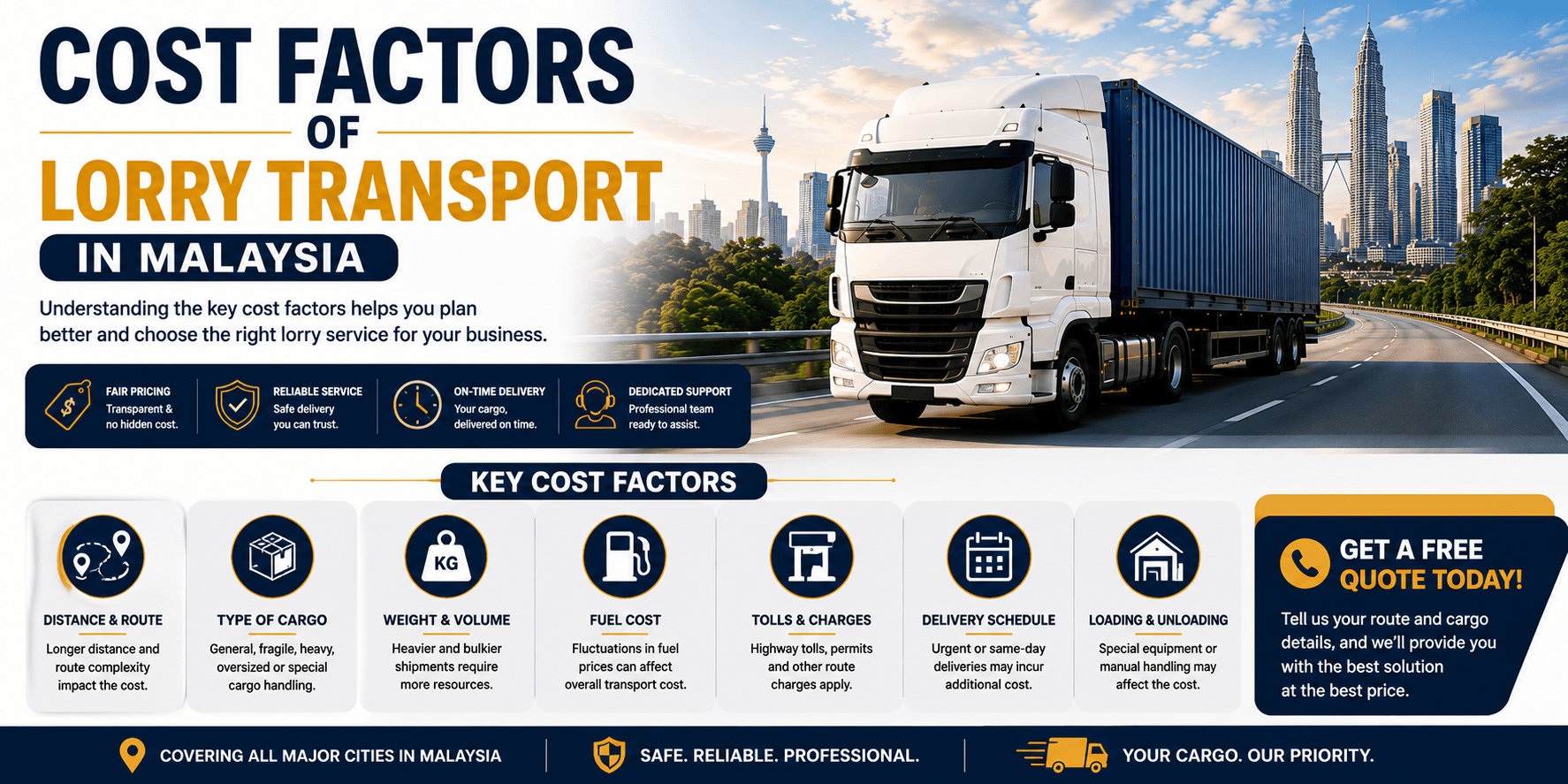
Commercial lorry transport in Malaysia supports thousands of business shipments every day, connecting manufacturers, warehouses, distributors, retailers and industrial facilities throughout Peninsular Malaysia. While road freight remains one of the most flexible and efficient methods of moving commercial cargo, lorry transport costs are influenced by far more than simply the distance travelled.
Every shipment has unique operational requirements. Factors such as cargo characteristics, vehicle allocation, delivery scheduling, route conditions and loading requirements all contribute to the overall cost of transportation. Understanding these cost factors of lorry transport in Malaysia allows businesses to plan freight more effectively, improve logistics budgeting and make informed operational decisions before arranging transport.
Rather than focusing solely on freight rates, businesses should understand how transport providers assess each shipment to determine the most appropriate vehicle, route and delivery plan.
How Logistics Providers Assess Commercial Transport Costs
Unlike parcel delivery services, commercial freight transportation does not follow a fixed pricing model. Every shipment is evaluated individually because cargo requirements, operational conditions and transport resources vary from one delivery to another.
Before planning a shipment, logistics providers typically assess:
- Pickup and delivery locations
- Total travelling distance
- Cargo dimensions and weight
- Type of commercial goods
- Vehicle size and configuration
- Loading and unloading requirements
- Preferred delivery schedule
- Site accessibility
- Operational constraints
- Cross-border requirements, where applicable
By evaluating these operational factors together, transport providers can allocate suitable vehicles, plan efficient delivery routes and coordinate freight movement more effectively.
1. Route Distance and Transportation Complexity
Distance remains one of the primary factors influencing commercial road freight costs, but it should not be viewed in isolation.
A longer journey generally requires greater fuel consumption, additional highway toll charges, longer driver operating hours and increased vehicle utilisation. However, the overall complexity of the transport route often has an equally significant impact on logistics planning.
Deliveries involving congested urban centres, multiple unloading points, restricted industrial zones or remote business locations typically require additional coordination compared with straightforward warehouse-to-warehouse transport.
For example, transporting cargo between Johor Bahru and Kuala Lumpur involves different operational planning compared with distributing goods across several delivery locations within the Klang Valley. Although the total distance may appear similar in some cases, route efficiency and delivery complexity can differ substantially.
2. Cargo Dimensions, Weight and Vehicle Utilisation
The physical characteristics of cargo influence how efficiently vehicle capacity can be utilised.
Large palletised shipments, bulky equipment or irregularly shaped freight may occupy significant trailer space even when overall weight remains relatively low. Conversely, dense industrial materials may reach vehicle weight limits while occupying less physical space.
Transport planners therefore evaluate both volume and weight when determining suitable vehicle allocation.
Important considerations include:
- Gross cargo weight
- Overall shipment dimensions
- Number of pallets
- Loading configuration
- Available vehicle capacity
- Weight distribution
Accurate shipment information enables better vehicle utilisation, helping businesses avoid unnecessary transport costs while improving fleet efficiency.
3. Cargo Characteristics and Handling Requirements
Different categories of commercial cargo require different transportation arrangements.
General palletised goods often require standard handling procedures, whereas specialised freight may require additional equipment, dedicated vehicles or more detailed operational planning.
Examples include:
- Manufacturing components
- Retail inventory
- FMCG products
- Industrial machinery
- Building materials
- Packaging supplies
- Fragile commercial goods
- Temperature-controlled products
- Dangerous Goods (DG)
Special handling requirements may influence loading methods, driver responsibilities, vehicle selection and overall transportation planning. Identifying these requirements early allows logistics providers to prepare appropriate equipment while supporting safe and efficient cargo movement.
4. Vehicle Selection and Fleet Allocation
One of the most significant operational decisions in commercial logistics is selecting the appropriate vehicle.
Different shipments require different transport solutions depending on cargo size, handling requirements and delivery destinations.
Common commercial vehicle types include:
- Box lorries
- Curtain-side trucks
- Tail lift lorries
- Refrigerated (reefer) trucks
- Crane lorries
- Low-bed trailers
- Prime movers with trailers
Selecting a larger vehicle than necessary may increase operating costs, while allocating insufficient capacity can require additional trips or create loading constraints.
Effective fleet allocation balances operational efficiency with transportation costs, ensuring cargo is moved safely while maximising vehicle utilisation.
5. Fuel Consumption, Highway Tolls and Operating Expenses
Fuel and vehicle operating expenses represent some of the largest ongoing costs in commercial road transport.
Long-distance freight, heavier cargo and specialised vehicles generally consume more fuel than standard deliveries. In addition, many commercial transport routes rely on Malaysia’s expressway network, where toll charges form part of normal operating expenses.
Transport providers must also account for vehicle maintenance, scheduled servicing, tyre wear, insurance, licensing, compliance requirements and driver operating hours when planning commercial freight operations.
These operational costs are not separate charges added afterwards—they form part of the overall transportation resources required to complete each shipment safely, reliably and efficiently. Understanding these underlying cost drivers gives businesses a clearer picture of how commercial freight is planned beyond the final transport quotation.
6. Delivery Schedule and Service Urgency
The required delivery timeline can influence transport planning and operating costs. Shipments that need immediate collection, fixed delivery windows or after-hours transportation often require additional scheduling flexibility and dedicated resources.
Businesses should communicate delivery expectations before booking so logistics providers can allocate suitable vehicles and plan routes efficiently.
Common scheduling requirements include:
- Same-day collections
- Next-day deliveries
- Scheduled delivery appointments
- Weekend or public holiday deliveries
- Time-specific warehouse receiving slots
Early planning allows transport providers to optimise schedules while helping businesses avoid unnecessary operational disruptions.
7. Loading, Unloading and Waiting Time
Transportation costs are influenced not only by driving time but also by the time spent at collection and delivery locations.
Delays during loading or unloading can affect vehicle availability and subsequent delivery schedules. Businesses that prepare cargo before the vehicle arrives can often improve loading efficiency and reduce overall transport delays.
Operational considerations may include:
- Forklift availability
- Loading dock access
- Manual loading requirements
- Waiting time at customer premises
- Site access restrictions
- Appointment-based warehouse receiving
Efficient site preparation benefits both businesses and logistics providers by improving vehicle turnaround times and supporting smoother daily transport operations.
8. Multi-Drop Deliveries and Route Planning
Some commercial shipments require deliveries to multiple locations during a single journey rather than one direct destination.
While multi-drop transportation improves vehicle utilisation, it also requires more detailed route planning, additional unloading activities and longer operating hours.
Factors affecting multi-drop transport include:
- Number of delivery locations
- Distance between stops
- Cargo allocation for each destination
- Delivery sequence
- Access to individual premises
Carefully planned delivery routes help minimise unnecessary travel while improving operational efficiency across multiple customer locations.
9. Cross-Border Transportation Requirements
Businesses transporting cargo between Malaysia and neighbouring countries may encounter additional operational requirements compared with domestic deliveries.
Cross-border transportation can involve:
- Customs documentation
- Border clearance procedures
- Cargo inspections
- Regulatory compliance
- Delivery coordination across multiple jurisdictions
These additional processes require more planning and operational coordination, which can influence both delivery schedules and transport costs. Businesses arranging international freight should provide complete shipment information well in advance to support efficient transport planning.
10. Vehicle Turnaround and Fleet Efficiency
One factor often overlooked by businesses is vehicle turnaround time.
Commercial vehicles operate on scheduled transport assignments throughout the day. Delays caused by extended loading times, incomplete documentation or inefficient delivery coordination reduce vehicle availability for subsequent shipments.
Efficient fleet utilisation allows logistics providers to maximise transport capacity while maintaining reliable service standards.
Businesses can support better fleet efficiency by:
- Preparing cargo before vehicle arrival
- Confirming shipment information in advance
- Providing accurate delivery instructions
- Coordinating receiving personnel
- Minimising loading delays
Small operational improvements can contribute to more efficient transport planning while helping control overall logistics costs.
Practical Ways to Optimise Lorry Transport Costs
Although some transportation costs are unavoidable, businesses can improve cost efficiency through better shipment planning rather than simply choosing the lowest quotation.
Practical strategies include:
- Consolidate shipments where appropriate
- Provide accurate cargo dimensions and weight
- Select vehicles that match shipment requirements
- Schedule deliveries in advance
- Reduce loading and unloading delays
- Share complete pickup and delivery information
- Coordinate recurring deliveries where possible
Improving operational planning allows businesses to make better use of transport resources while supporting consistent freight movement across their supply chain.
Cost-Efficient Lorry Transport by J&G Global Logistics
J&G Global Logistics supports businesses across Malaysia with practical lorry transport solutions designed around operational efficiency rather than one-size-fits-all transportation. Every shipment is assessed based on cargo characteristics, delivery requirements, route conditions and vehicle suitability to help businesses optimise transport resources while maintaining dependable freight movement.
By carefully coordinating vehicle allocation, route planning and delivery schedules, J&G Global Logistics assists manufacturers, distributors, wholesalers, retailers and warehouse operators in managing commercial cargo efficiently throughout Peninsular Malaysia.
Whether transporting regular business shipments, industrial materials or warehouse inventory, a structured logistics approach helps businesses improve transport efficiency while maintaining greater control over operating costs.
Looking for dependable lorry transport in Malaysia? Contact J&G Global Logistics today to discuss your cargo requirements, request a quotation or learn more about our commercial road freight solutions.
Frequently Asked Questions
Lorry transport costs mainly depend on travel distance, cargo size, vehicle type, delivery requirements and operational conditions. Factors such as loading requirements, route complexity, waiting time and specialised cargo handling may also influence the overall transportation cost depending on the shipment.
Not necessarily. While heavier shipments may require larger vehicles or affect vehicle capacity, transport costs also depend on cargo dimensions, handling requirements, delivery locations and route planning rather than weight alone.
Different logistics providers calculate transportation costs based on their fleet, operating expenses, route planning, available vehicle capacity and included services. Comparing quotations should involve evaluating both pricing and the scope of services provided.
Yes. Providing accurate cargo information, scheduling deliveries in advance and preparing loading arrangements can improve operational efficiency, helping logistics providers allocate suitable vehicles and coordinate freight more effectively.
Selecting the right vehicle improves operational efficiency by matching cargo size and handling requirements with available carrying capacity. Using an unsuitable vehicle may increase operating costs or reduce transport efficiency.
Yes. Delays at pickup or delivery locations reduce vehicle availability and can disrupt scheduled transport operations. Preparing cargo and coordinating site access before vehicle arrival helps improve delivery efficiency.
Cross-border transportation may involve additional operational requirements such as customs procedures, regulatory documentation and border clearance.
Understanding the operational factors behind lorry transport costs helps businesses plan shipments more effectively, allocate logistics budgets accurately and make informed transportation decisions that support long-term supply chain efficiency.