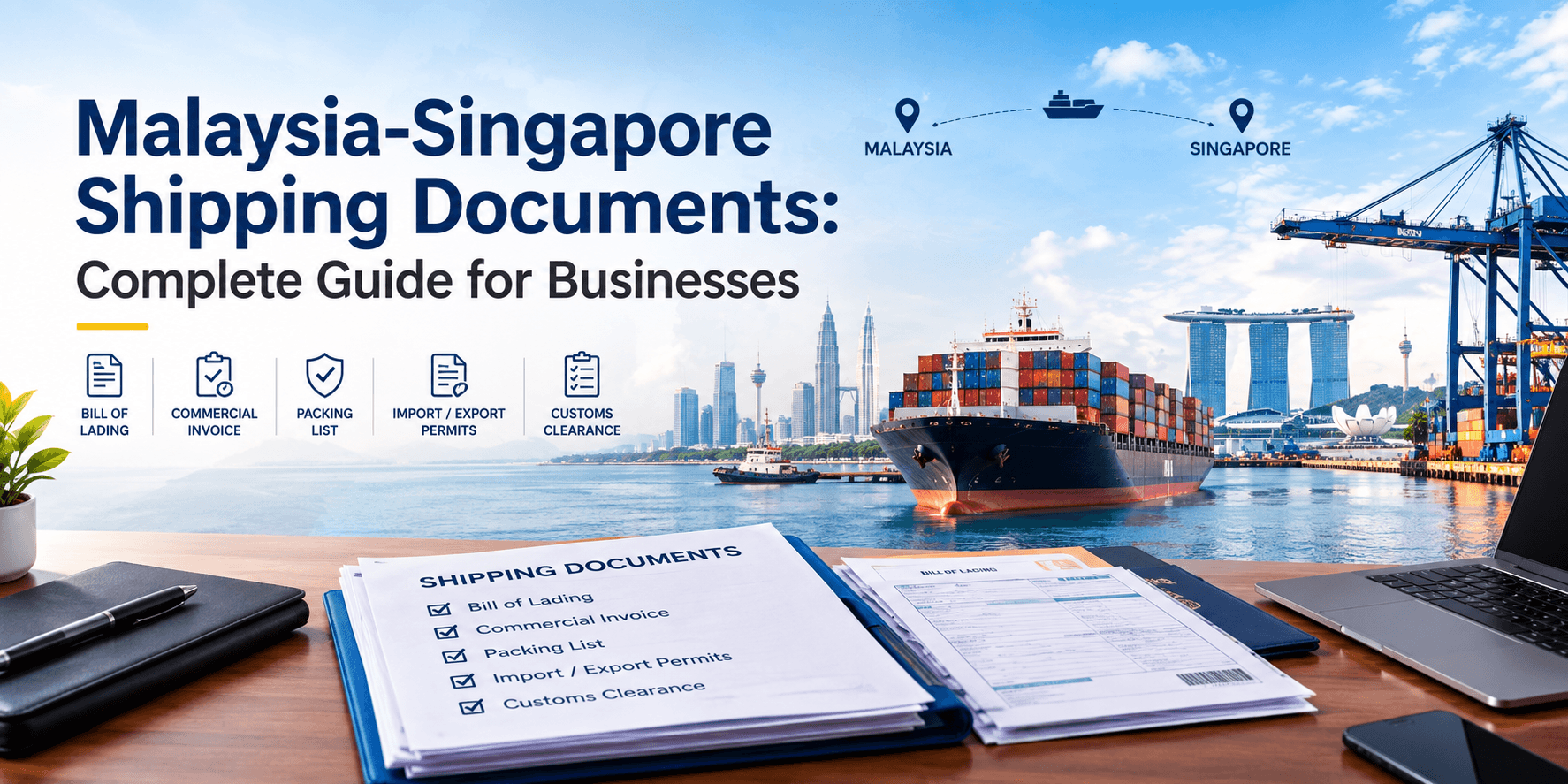
Shipping commercial cargo between Malaysia and Singapore requires more than arranging transportation. Businesses must prepare the correct Malaysia Singapore shipping documents to support customs declarations, cargo identification and cross-border movement.
The type of goods, shipment method, cargo value, customs requirements and applicable regulations determine the exact documentation businesses need.
For businesses involved in Malaysia-Singapore trade, understanding the basic documentation process can help reduce avoidable delays and make it easier to coordinate with customs representatives, freight forwarders and transport providers.
What Documents Do Businesses Need to Ship Goods From Malaysia to Singapore?
Common Malaysia-Singapore shipping documents may include:
- Commercial invoice
- Packing list
- Singapore customs import permit, where required
- Applicable Malaysian export documentation
- Transport or consignment documentation
- Certificate of Origin, where applicable
- Licences, permits or certificates for controlled or regulated goods, where applicable
The exact documents depend on the shipment.
For example, Singapore Customs specifies different document requirements for containerised cargo, conventional cargo, hand-carried goods and air imports. For certain land imports, the required documents can include a customs permit, commercial invoice and packing list, while an air waybill is not applicable to land imports.
This means businesses should avoid assuming that every Malaysia-Singapore shipment uses exactly the same paperwork.
Malaysia Singapore Shipping Documents Checklist
| Document | Main Purpose | Usually Relevant When |
|---|---|---|
| Commercial Invoice | Provides transaction and cargo details | Commercial shipments |
| Packing List | Shows packages, quantities and shipment details | When goods are packed for transport |
| Customs Import Permit | Supports Singapore import declaration | Where required for the shipment |
| Export Documentation | Supports Malaysian export procedures | Depending on the export |
| Transport Document | Identifies the movement of cargo | Depending on transport mode |
| Certificate of Origin | Provides evidence of origin where applicable | When required or used for preferential treatment |
| Special Permit or Licence | Supports movement of controlled or regulated goods | Where applicable |
This table is a practical overview, not a universal checklist. The actual requirements should be confirmed for each shipment.
1. Commercial Invoice
Businesses use a commercial invoice to describe the transaction and the goods they ship.
Depending on the transaction, it may contain information such as:
- Exporter or seller details
- Importer or buyer details
- Description of the goods
- Quantity
- Unit price
- Total value
- Currency
- Invoice number
- Terms of sale, where applicable
The information on the invoice should be consistent with the other documents accompanying the shipment.
Singapore Customs identifies commercial invoices among the supporting documents used for cargo clearance.
Why is the commercial invoice important?
Customs authorities need accurate information about the goods and their commercial value when processing import and export declarations.
Incorrect descriptions, values or other inconsistencies can create questions during the clearance process.
2. Packing List
A packing list provides details about how the goods are physically packed.
It can include information such as:
- Number of packages
- Package type
- Quantity of goods
- Gross weight
- Net weight
- Dimensions
- Marks and numbers
- Description of the contents
For example, a shipment may consist of several cartons, pallets or other packages. The packing list allows the shipment details to be presented in a structured format.
Singapore Customs lists packing lists among the supporting documents used for relevant cargo clearance procedures.
Why should the packing list match the cargo?
The physical shipment should correspond with the information documented for customs and transport purposes.
Differences between the declared information and the actual cargo can create additional questions or verification requirements.
3. Singapore Customs Import Permit
Businesses importing goods into Singapore should understand the role of the Singapore Customs import permit.
Singapore Customs states that goods imported into Singapore require a Customs Import Permit submitted through TradeNet. Importers can either apply through the appropriate process themselves or appoint a Declaring Agent to apply on their behalf.
Before applying, businesses should consider factors such as:
- The classification of the goods
- Whether the goods are controlled or prohibited
- Applicable licensing requirements
- The applicable customs procedure
- Supporting documentation
Singapore Customs also recommends checking the correct Harmonised System (HS) code and determining whether additional restrictions or licensing requirements apply.
Who submits the import permit?
The importer may work with a Declaring Agent to submit the permit on its behalf.
The exact arrangement depends on the parties involved in the shipment.
Businesses should therefore establish who is responsible for customs declarations before the cargo is dispatched.
4. Malaysian Export Documentation
The Malaysian side of a Malaysia-Singapore shipment may also require export-related declarations and supporting documents.
The specific requirements depend on the nature of the goods, the applicable customs procedure and whether the goods are subject to additional controls.
Businesses should not assume that every shipment leaving Malaysia requires an identical set of documents.
Before shipping, the exporter should confirm:
- The correct description of the goods
- Applicable tariff or HS classification
- Required export declaration
- Whether the goods are controlled
- Whether an export permit or approval is required
- Supporting documents required by the relevant authorities
This is particularly important when dealing with regulated or controlled products.
5. Transport Documents
Transport documentation identifies and supports the movement of cargo.
The document used depends on the transport method and shipment arrangement.
For example:
- Sea freight may use a Bill of Lading.
- Air freight commonly uses an Air Waybill.
- Land transportation may use a consignment note or other applicable transport documentation.
Singapore Customs specifically distinguishes documentation requirements according to the mode of import. For containerised land imports, for example, an Air Waybill is not applicable.
Businesses should therefore use the transport document appropriate to the actual shipment method.
6. Certificate of Origin
A Certificate of Origin provides information about where goods originate.
It may become relevant when:
- A trade agreement provides preferential tariff treatment
- The importing country requires proof of origin
- A buyer requests origin documentation
- A particular customs procedure requires it
Businesses should not automatically treat a Certificate of Origin as mandatory for every Malaysia-Singapore shipment.
The shipment circumstances and applicable customs or trade requirements determine whether businesses need one.
Businesses seeking preferential tariff treatment should verify the applicable rules of origin and documentation requirements before shipping.
7. Documents for Controlled or Regulated Goods
Some products may be subject to additional controls.
Examples can include goods regulated because of their:
- Composition
- Intended use
- Safety characteristics
- Health implications
- Strategic nature
- Environmental impact
- Other regulatory considerations
Singapore Customs advises businesses to check whether authorities control or prohibit the goods and to identify the relevant Competent Authority requirements before applying for permits.
Additional documentation may therefore include licences, certificates, approvals or other regulatory documents.
Do not assume that a standard commercial invoice and packing list are sufficient for controlled goods.
The applicable authority and requirements should be confirmed before the shipment moves.
8. Dangerous Goods and Special Cargo
Cargo with special handling or regulatory requirements may require additional documentation and procedures.
The requirements can depend on the actual characteristics of the goods and the applicable regulations.
Businesses should provide accurate information about the cargo before booking transportation, particularly when the shipment could involve:
- Dangerous goods
- Chemicals
- Batteries
- Flammable products
- Regulated substances
- Temperature-sensitive products
- Oversized or unusually heavy cargo
Businesses must classify the goods correctly because the classification can affect transport and regulatory requirements.
9. HS Codes and Why They Matter
An HS code is a classification used to identify goods for customs purposes.
Correct classification can affect:
- Customs declarations
- Applicable duties or taxes
- Import or export controls
- Licensing requirements
- Statistical reporting
- Preferential tariff treatment where applicable
Singapore Customs specifically advises businesses to ensure that they have the correct HS code and to use the relevant product-code checking resources to identify applicable restrictions and duty rates.
Businesses should avoid guessing an HS code simply because a product appears similar to another item.
When classification is uncertain, the importer, exporter or appointed customs representative should verify the appropriate classification.
10. Who Is Responsible for Preparing the Shipping Documents?
Responsibility can be divided among several parties.
Exporter
The exporter may be responsible for providing commercial information about the goods, including:
- Commercial invoice
- Packing information
- Product descriptions
- Origin information
- Other documents required for the export
Importer
The importer may be responsible for:
- Import requirements
- Customs declarations
- Import permits
- Duties and taxes where applicable
- Regulatory approvals
Customs or Declaring Agent
Where an agent is appointed, the agent may handle customs declaration and permit-related processes on behalf of the relevant party.
Singapore Customs confirms that importers can appoint a Declaring Agent to apply for permits on their behalf.
Transport or Freight Provider
A transport or freight provider may require shipment information and documentation to arrange the movement of the cargo.
However, businesses should clearly confirm the scope of services being provided rather than assuming that every logistics provider handles customs declarations or regulatory approvals.
11. What Businesses Should Check Before Booking Malaysia-Singapore Freight
Before arranging transportation, prepare the basic shipment information.
A useful checklist includes:
Cargo Information
- What are the goods?
- How many packages are there?
- What is the total weight?
- What are the package dimensions?
- How are the goods packed?
- Are the goods controlled or regulated?
Commercial Information
- Who is the exporter?
- Who is the importer?
- What is the commercial value?
- What currency is being used?
- Is a Certificate of Origin relevant?
Transport Information
- Where is the cargo being collected?
- Where is it being delivered?
- What transport mode will be used?
- What is the required delivery date?
- Is special handling required?
Customs Information
- What is the correct HS code?
- Is an import permit required?
- Are additional licences or approvals required?
- Who is responsible for the customs declaration?
Providing this information early can make it easier for the relevant parties to determine what documentation is needed.
12. Example: Preparing Documents for a Commercial Shipment
Consider a hypothetical business sending packaged commercial goods from Malaysia to a company in Singapore.
The business may need to prepare information such as:
- Commercial invoice
- Packing list
- Product description
- HS classification
- Applicable Malaysian export documentation
- Singapore import permit requirements
- Appropriate transport documentation
- Certificate of Origin, if applicable
- Additional licences or approvals, if the goods are controlled
The example is intentionally general because the actual documentation depends on the goods and shipment arrangement.
A shipment of ordinary commercial products may have different requirements from a shipment involving controlled goods, regulated products or goods requiring special treatment.
13. Common Malaysia Singapore Shipping Documentation Mistakes
1. Using an inaccurate product description
A vague description can make it more difficult to determine the correct classification and regulatory requirements.
Instead of using a generic description, businesses should provide an accurate description of what the product actually is.
2. Incorrect quantities
The quantities shown on the invoice and packing list should accurately represent the shipment.
3. Incorrect weights or dimensions
Incorrect cargo measurements can affect transportation arrangements and documentation.
4. Using the wrong HS code
Incorrect classification can affect customs processing and applicable requirements.
5. Assuming every shipment needs the same documents
Documentation requirements vary according to factors such as cargo type and transport mode.
6. Waiting until the cargo is ready to check requirements
Documentation problems are easier to address before the shipment has already been dispatched.
7. Failing to identify controlled goods
Businesses should check whether their goods are controlled or prohibited before arranging the shipment. Singapore Customs specifically recommends checking this before applying for permits.
14. What Happens If Shipping Documents Are Incomplete?
Incomplete or inaccurate documentation can create additional checks or delay the clearance process.
The exact consequences depend on the circumstances of the shipment and the nature of the documentation issue.
Potential problems may include:
- Additional information requests
- Customs verification
- Delays in clearance
- Additional administrative work
- Incorrect declarations needing correction
- Additional regulatory checks
For this reason, documentation should be reviewed before cargo is dispatched.
15. How to Organise Malaysia-Singapore Shipping Documents
A simple document-control process can reduce confusion.
Create a shipment folder containing:
- Commercial invoice
- Packing list
- Customs permit documentation
- Export documentation
- Transport documents
- Certificates of origin, where applicable
- Special permits or licences, where applicable
- Relevant correspondence
Businesses importing into Singapore should also be aware of Singapore Customs’ record-retention requirements. Singapore Customs requires businesses and their Declaring Agents to retain relevant trade documents for at least five years after approving the permit.
The documents covered include commercial invoices, Bills of Lading or Air Waybills, packing lists, certificates and other records related to the movement or sale of goods.
16. How a Logistics Provider Can Help
A logistics provider can be involved in different parts of a cross-border shipment depending on the services agreed with the customer.
Possible areas of support may include:
- Coordinating transportation
- Collecting shipment information
- Coordinating with customs representatives
- Preparing transport documentation
- Communicating shipment requirements
- Coordinating pickup and delivery
- Helping identify information that may need to be provided for customs processing
However, the exact responsibilities vary between logistics providers and service agreements.
Businesses should confirm in advance whether their chosen provider handles:
- Customs declarations
- Import permits
- Export declarations
- Documentation preparation
- Customs clearance
- Transport only
This distinction is important because transportation and customs declaration are not automatically the same service.
17. Malaysia-Singapore Cross-Border Shipping Process
A typical commercial shipment may follow a process such as:
Step 1: Identify the Cargo
Determine exactly what is being shipped, including its quantity, weight, dimensions and characteristics.
Step 2: Confirm Classification
Determine the appropriate HS classification and check whether the goods are controlled or subject to additional requirements.
Singapore Customs recommends confirming the correct HS code and checking the status of the goods before applying for a permit.
Step 3: Prepare Commercial Documents
Prepare the commercial invoice, packing list and other relevant documentation.
Step 4: Confirm Export Requirements
The exporter should verify the applicable Malaysian export procedures and requirements.
Step 5: Confirm Singapore Import Requirements
The importer should establish the applicable Singapore import requirements and permit arrangements.
Singapore Customs states that import permits are submitted through TradeNet.
Step 6: Arrange Transportation
Once the shipment information and documentation requirements are understood, transportation can be coordinated.
Step 7: Complete Customs Clearance
The relevant customs declarations and clearance procedures are completed according to the shipment.
Step 8: Deliver the Cargo
After the necessary clearance procedures are completed, the shipment can continue to its destination according to the agreed transportation arrangement.
18. Final Malaysia Singapore Shipping Documents Checklist
Before sending commercial cargo from Malaysia to Singapore, review the following:
Cargo
- Accurate product description
- Correct quantity
- Correct weight
- Correct dimensions
- Correct packaging information
- Controlled-goods status checked
Commercial Documentation
- Commercial invoice
- Packing list
- Origin information, where applicable
- Certificate of Origin, where applicable
Customs
- HS code checked
- Malaysian export requirements checked
- Singapore import requirements checked
- Import permit requirements confirmed
- Additional licences or approvals checked
Transportation
- Pickup location confirmed
- Delivery address confirmed
- Transport mode confirmed
- Appropriate transport documentation prepared
- Special handling requirements communicated
Records
- Copies of relevant documents retained
- Shipment documentation organised for future reference
Frequently Asked Questions
Common documents can include a commercial invoice, packing list, applicable customs permits or declarations and transport documentation. Additional documents may be required depending on the type of goods and shipment.
Businesses may need commercial invoices, packing lists, export and import documentation, transport documents and applicable permits or certificates. Requirements vary depending on the cargo.
A commercial invoice is an important document for commercial shipments because it provides information about the transaction, goods and value.
Businesses commonly use a packing list to provide details about the physical cargo, including package quantities, weights and descriptions.
Singapore generally requires an import permit for imported goods, subject to applicable procedures and exemptions. Businesses should confirm the requirements for their specific shipment.
No. The goods, their origin, the applicable trade arrangement and the document’s purpose determine whether businesses need proof of origin.
Yes. Controlled goods may require additional permits, licences or approvals from the relevant authorities.
Incomplete or inconsistent documentation can result in requests for additional information, additional checks or potential clearance delays.
Yes. we provides commercial transportation and logistics services for businesses moving cargo between Malaysia and Singapore.