Businesses across Malaysia depend on trucking services in Malaysia to transport commercial goods efficiently between manufacturing facilities, warehouses, distribution centres, retail outlets and customer locations. Whether moving a full truckload of inventory or a smaller shipment that can share vehicle space, selecting the right transportation method can significantly influence delivery efficiency, transportation costs and overall supply chain performance.
One of the most important decisions businesses make when arranging trucking services is whether to choose Full Truck Load (FTL) or Less Than Truck Load (LTL) transportation. Each option is designed for different shipment requirements, and understanding the differences helps businesses select the most suitable solution for their cargo, delivery schedules and operational priorities.
Rather than simply choosing the lowest transportation cost, businesses should evaluate shipment size, delivery urgency, cargo handling requirements and scheduling flexibility before deciding between FTL and LTL transportation.
What Are Trucking Services?
Trucking services refer to the transportation of commercial cargo using freight vehicles between business locations throughout Malaysia. They form an essential part of domestic logistics, supporting manufacturers, wholesalers, retailers, distributors and warehouse operators by moving goods safely and efficiently across established transportation networks.
Businesses commonly use trucking services in Malaysia for:
- Commercial freight transportation
- Manufacturing materials movement
- Warehouse replenishment
- Distribution centre transfers
- Retail inventory deliveries
- Industrial equipment transportation
- Scheduled recurring freight
- Business-to-business cargo movement
By coordinating freight between key commercial centres, trucking services help businesses maintain inventory levels, fulfil customer orders and support uninterrupted supply chain operations.
Understanding FTL and LTL Transportation
Businesses generally choose between two primary transportation models depending on cargo volume and operational requirements:
- Full Truck Load (FTL)
- Less Than Truck Load (LTL)
While both options transport commercial cargo efficiently, they serve different business needs and offer distinct operational advantages.
What Is Full Truck Load (FTL)?
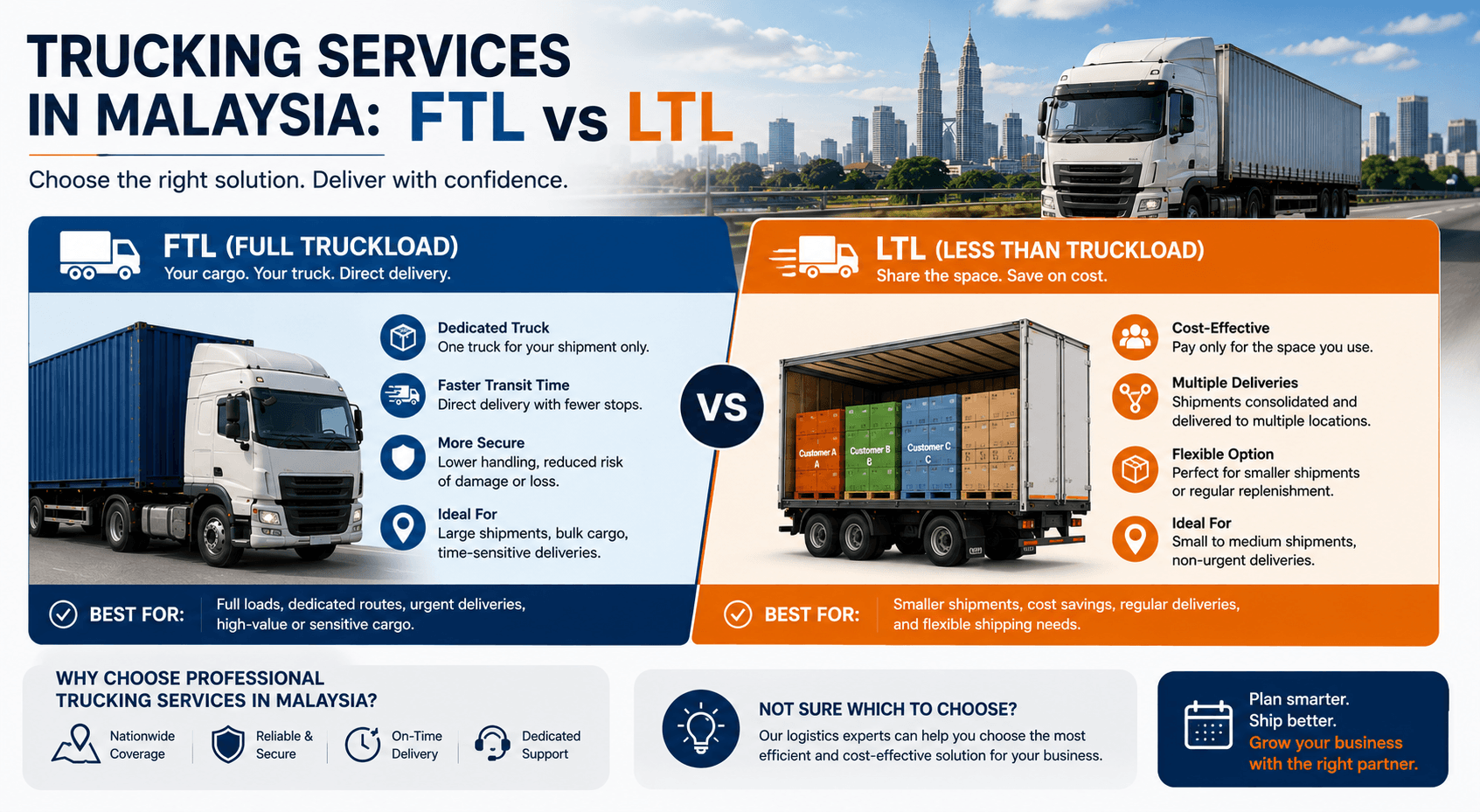
Full Truck Load (FTL) transportation is used when a shipment occupies most or all of a truck’s available capacity. The vehicle is dedicated to a single customer’s cargo, allowing goods to travel directly between the pickup and delivery locations without sharing space with other shipments.
FTL transportation is commonly selected for:
- Large shipment volumes
- Manufacturing goods
- Warehouse replenishment
- Industrial equipment
- High-value commercial cargo
- Time-sensitive deliveries
- Recurring business shipments
Because the cargo remains on a dedicated vehicle throughout the journey, FTL often involves fewer handling points and more direct transportation between locations.
Advantages of FTL Transportation
Businesses may choose FTL trucking services because they offer:
- Dedicated vehicle capacity
- Reduced cargo handling during transit
- More direct transportation routes
- Greater scheduling flexibility
- Suitable transportation for larger commercial shipments
FTL is particularly beneficial for businesses that require consistent transportation schedules or regularly move large quantities of goods between facilities.
What Is Less Than Truck Load (LTL)?
Less Than Truck Load (LTL) transportation is designed for shipments that do not require an entire truck. Multiple shipments from different businesses are consolidated into a single vehicle travelling along a similar route, allowing transportation resources to be shared more efficiently.
LTL transportation is commonly used for:
- Smaller commercial shipments
- Regular inventory replenishment
- Retail deliveries
- Business supplies
- Warehouse stock transfers
- Small-volume freight
For businesses with lower shipment volumes, LTL provides an efficient transportation solution without requiring dedicated vehicle capacity.
Advantages of LTL Transportation
Businesses often choose LTL trucking services because they provide:
- Cost-efficient transportation for smaller shipments
- Flexible shipment scheduling
- Efficient use of vehicle capacity
- Suitable transportation for recurring lower-volume freight
- Practical logistics for businesses that do not require dedicated trucks
LTL transportation is particularly valuable for SMEs, distributors, wholesalers and businesses managing regular but smaller cargo movements.
FTL vs LTL: What’s the Difference?
| Transportation Factor | Full Truck Load (FTL) | Less Than Truck Load (LTL) |
|---|---|---|
| Shipment volume | Large shipments | Smaller shipments |
| Vehicle allocation | Dedicated vehicle | Shared vehicle |
| Cargo handling | Reduced handling | Consolidated with other freight |
| Delivery routing | Direct transportation | Multiple delivery stops may occur |
| Best suited for | High-volume or urgent cargo | Cost-efficient smaller shipments |
| Common users | Manufacturers, distributors, warehouse operators | SMEs, retailers, wholesalers, e-commerce businesses |
Understanding these operational differences helps businesses select the transportation model that best aligns with their logistics requirements rather than focusing solely on transportation costs.
Which Businesses Should Choose FTL?
Full Truck Load (FTL) transportation is typically the preferred option for businesses moving large shipment volumes or requiring dedicated vehicle capacity. Since the truck is allocated to a single shipment, FTL allows businesses to better coordinate delivery schedules and minimise unnecessary cargo handling.
Businesses commonly choosing FTL trucking services in Malaysia include:
Manufacturers
Manufacturers frequently transport raw materials, production components and finished goods between factories, warehouses and customers. Dedicated transportation helps support production schedules and inventory planning.
Distributors and Wholesalers
Businesses distributing products across multiple regions often require FTL transportation to replenish warehouses and supply commercial customers efficiently.
Warehouse Operators
Warehouse operators regularly coordinate high-volume inventory transfers between storage facilities and distribution centres throughout Malaysia.
Businesses with Time-Sensitive Freight
Where delivery schedules are critical, FTL transportation provides greater control over routing and shipment coordination.
Which Businesses Should Choose LTL?
Less Than Truck Load (LTL) transportation is often the preferred choice for businesses that move smaller shipment volumes on a regular basis. Rather than paying for an entire vehicle, businesses share transportation capacity with other compatible shipments, making logistics planning more cost-efficient.
LTL transportation is commonly used by:
Small and Medium Enterprises (SMEs)
Businesses with moderate freight requirements often benefit from transportation solutions that match their shipment volume.
Retail Businesses
Retailers frequently use LTL transportation to replenish inventory without waiting to accumulate a full truckload.
E-commerce Companies
Growing online businesses often move smaller quantities of stock between warehouses, fulfilment centres and distribution facilities.
Wholesalers
Wholesalers supplying multiple customers with smaller orders may find LTL transportation more practical for recurring deliveries.
Factors to Consider When Choosing Between FTL and LTL
Choosing between FTL and LTL trucking services depends on more than shipment size. Businesses should evaluate several operational factors before arranging transportation.
Cargo Volume
The amount of cargo being transported is often the first consideration. Larger shipments generally benefit from dedicated transportation, while smaller shipments may be more suitable for consolidated freight.
Delivery Timeline
Businesses working with strict production schedules or customer delivery commitments may require the greater scheduling flexibility offered by FTL transportation.
Transportation Budget
Businesses should balance transportation costs with operational efficiency. While LTL can reduce costs for smaller shipments, FTL may provide greater value for high-volume or recurring freight.
Cargo Handling Requirements
Fragile, high-value or specialised commercial goods may benefit from transportation arrangements that reduce cargo transfers during transit.
Shipment Frequency
Businesses arranging regular transportation should evaluate whether recurring shipment volumes justify dedicated transportation or consolidated freight solutions.
Common Freight Routes for Trucking Services in Malaysia
Businesses rely on trucking services in Malaysia to connect major commercial, manufacturing and distribution centres across the country.
Some of the most frequently used freight routes include:
Johor Bahru to Kuala Lumpur
One of Malaysia’s busiest freight corridors, supporting manufacturers, distributors, wholesalers and retailers transporting commercial goods between southern and central Peninsular Malaysia.
Johor Bahru to Selangor
Businesses regularly transport warehouse stock, manufacturing materials and retail inventory between Johor Bahru and Selangor’s industrial and commercial hubs.
Johor Bahru to Penang
Manufacturers and distributors frequently coordinate freight movement between Johor Bahru and Penang to support production facilities, warehouses and commercial supply chains.
Inter-State Transportation Throughout Peninsular Malaysia
Many businesses require recurring freight movement between multiple states to maintain inventory levels, support customer fulfilment and strengthen supply chain operations.
Common Cargo Transported by Trucking Services
Commercial trucking supports a wide variety of industries throughout Malaysia.
Common cargo transported includes:
- Retail inventory
- FMCG products
- Manufacturing materials
- Packaging materials
- Industrial equipment
- Warehouse stock
- Business supplies
- Commercial goods
- Palletised cargo
Understanding cargo characteristics allows logistics providers to recommend appropriate transportation arrangements and improve delivery planning.
Choosing the Right Trucking Company in Malaysia
Selecting a trucking provider involves more than comparing transportation rates. Businesses should look for a logistics partner capable of supporting both current operational requirements and long-term business growth.
When evaluating a trucking company in Malaysia, consider:
- Experience handling commercial freight
- Support for both FTL and LTL transportation
- Coverage across major freight routes in Malaysia
- Clear communication throughout the transportation process
- Reliable scheduling and delivery coordination
- Ability to support recurring business shipments
- Understanding of domestic logistics requirements
A dependable trucking partner helps businesses improve transportation efficiency while supporting reliable supply chain performance.
Trucking Services by J&G Global Logistics
J&G Global Logistics supports businesses requiring reliable trucking services in Malaysia through flexible transportation solutions tailored to commercial freight requirements. Whether businesses require Full Truck Load (FTL) or Less Than Truck Load (LTL) transportation, the company assists with planning, coordinating and managing freight movement across major commercial routes throughout Peninsular Malaysia.
With experience supporting manufacturers, distributors, wholesalers, retailers and warehouse operators, J&G Global Logistics focuses on dependable transportation, clear communication and efficient logistics coordination to help businesses maintain smooth supply chain operations.
Whether transporting large commercial shipments or smaller recurring freight, choosing the appropriate trucking solution helps businesses optimise transportation efficiency while supporting long-term operational performance.
Looking for reliable trucking services in Malaysia? Contact J&G Global Logistics today to discuss your freight requirements, request a quotation or learn more about our FTL and LTL transportation solutions.
Frequently Asked Questions
Trucking services in Malaysia refer to the transportation of commercial goods by road between manufacturing facilities, warehouses, distribution centres, retail outlets and customer locations. These services support domestic freight movement and help businesses maintain efficient supply chain operations throughout Peninsular Malaysia.
Full Truck Load (FTL) uses a dedicated truck for a single customer’s shipment, while Less Than Truck Load (LTL) combines multiple smaller shipments from different businesses into one vehicle. The right option depends on shipment size, delivery requirements, transportation budget and operational priorities.
Businesses transporting large shipment volumes, high-value cargo or time-sensitive freight typically benefit from FTL transportation because it provides dedicated vehicle capacity and more direct delivery. Manufacturers, distributors, warehouse operators and industrial businesses commonly choose FTL for recurring commercial shipments.
LTL transportation is suitable for businesses with smaller shipment volumes that do not require a dedicated truck. SMEs, retailers, wholesalers, distributors and e-commerce businesses often use LTL to optimise transportation costs while maintaining regular freight movement.
The most cost-effective option depends on shipment size, delivery requirements and operational priorities. Smaller shipments generally benefit from LTL transportation, while larger shipments often gain greater efficiency through FTL.
Commercial trucking services commonly transport retail inventory, warehouse stock, manufacturing materials, FMCG products, industrial equipment, packaging materials and general commercial freight.
Businesses frequently use trucking services in Malaysia to transport cargo between Johor Bahru, Kuala Lumpur, Selangor, Penang and other major commercial and industrial centres. These freight corridors support domestic distribution, manufacturing logistics and ongoing supply chain operations.
Businesses should choose a trucking company with experience in commercial freight, nationwide route coverage, reliable communication and support for both FTL and LTL transportation. Evaluating these factors helps ensure efficient freight coordination, dependable deliveries and long-term logistics support.