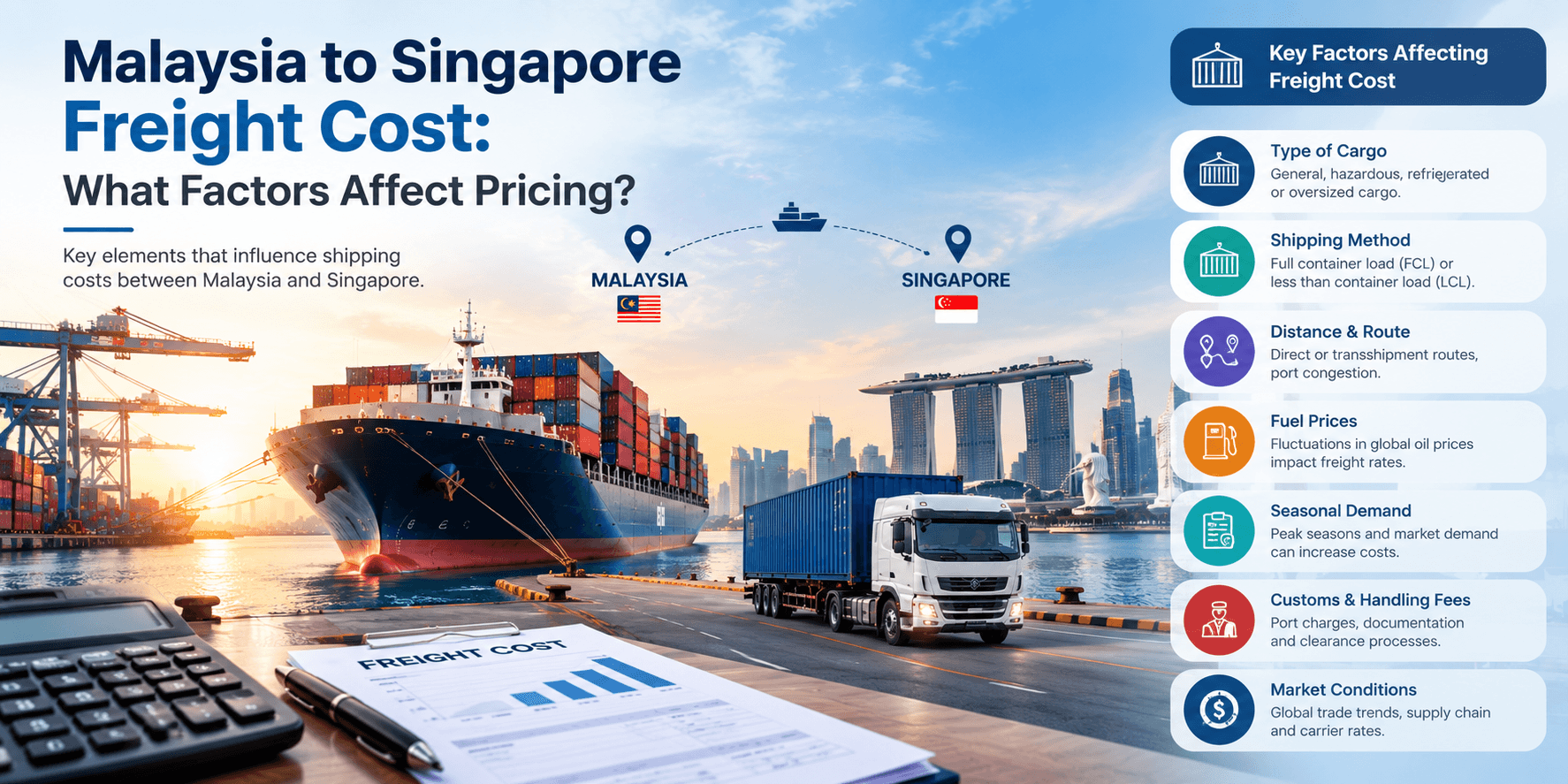
The Malaysia to Singapore freight cost depends on several shipment-specific factors rather than one fixed rate. The main factors include cargo weight and dimensions, pickup and delivery locations, transportation mode, FTL or LTL requirements, cargo type, handling requirements, and cross-border documentation.
Other costs, such as customs duties, permits or additional handling charges, may apply depending on the shipment and should be confirmed separately when requesting a quotation.
Because every commercial shipment is different, businesses should provide complete cargo and route information to receive an accurate freight quotation.
Key Factors That Affect Malaysia to Singapore Freight Cost
1. Cargo Weight and Dimensions
The weight and size of your cargo are two of the most important factors when calculating freight charges from Malaysia to Singapore.
A shipment may be lightweight but occupy significant vehicle space. Conversely, a compact shipment may be heavier but require less space.
When requesting a freight quotation, provide:
- Total cargo weight
- Number of cartons or pallets
- Length, width and height
- Total volume, if available
- Whether the cargo is stackable
- Number of individual packages
Accurate cargo measurements help determine the transportation capacity required for the shipment.
2. FTL vs LTL Transportation
The type of transportation arrangement can also affect the Malaysia Singapore freight cost.
FTL (Full Truckload) is generally used when a shipment requires a dedicated truck or significant vehicle capacity.
LTL (Less Than Truckload) is generally used when a shipment does not require the entire truck and can be transported as part of a shared freight arrangement, subject to the cargo and service requirements.
The more suitable option depends on the shipment size, cargo characteristics, and delivery requirements.
For businesses comparing these options, our guide on FTL vs LTL transportation provides more information.
3. Pickup Location in Malaysia
The pickup point can influence the total transportation cost.
A shipment collected from Johor, for example, may have different transportation requirements from cargo collected from another part of Malaysia.
When requesting a quotation, provide the complete pickup location and, where relevant:
- Warehouse or factory access information
- Loading conditions
- Operating hours
- Vehicle access restrictions
- Collection requirements
The more accurate the pickup information, the easier it is to assess the transportation requirements.
4. Delivery Location in Singapore
The final delivery destination is another important factor.
Freight requirements can vary depending on whether cargo is delivered to a warehouse, industrial facility, commercial premises, construction site or another location.
Businesses should provide:
- Full delivery address
- Receiving hours
- Site access information
- Loading or unloading requirements
- Any delivery restrictions
These details help avoid misunderstandings when comparing freight quotations.
5. Transportation Mode
The choice of transportation mode can have a significant impact on shipping cost from Malaysia to Singapore.
Common options include:
Road Freight
Road freight is commonly considered for commercial cargo moving between Malaysia and Singapore, particularly where the shipment requires direct land transportation.
The cost depends on factors such as cargo size, route, truck requirements, loading and delivery conditions, and cross-border requirements.
Sea Freight
Sea freight may be suitable for certain larger or less time-sensitive shipments. Businesses may consider FCL or LCL depending on the volume and characteristics of the cargo.
Air Freight
Air freight is generally considered when faster transportation is important or when the cargo is suitable for air transportation.
It’s pricing can depend heavily on chargeable weight and dimensions.
The best transportation mode depends on the cargo, budget and delivery requirements.
6. Cargo Type and Handling Requirements
The type of cargo can affect the transportation arrangement.
Standard commercial goods may have straightforward handling requirements, while certain shipments may require additional planning.
Examples include:
- Heavy machinery
- Oversized cargo
- Fragile goods
- Temperature-sensitive products
- Dangerous goods
- Controlled goods
Businesses should always disclose special cargo characteristics before requesting a quotation.
For regulated or controlled goods, additional documentation, permits or approvals may apply.
7. Loading and Unloading Requirements
The way cargo is loaded and unloaded can also influence transportation requirements.
For example, a shipment consisting of standard pallets may have different requirements from large crates or heavy individual items.
Before booking transportation, clarify whether the shipment requires:
- Additional loading assistance
- Special unloading arrangements
- Specific equipment
- Restricted-site delivery procedures
- Special packaging or handling
This helps ensure that the quotation reflects the actual shipment requirements.
8. Customs and Cross-Border Documentation
Moving commercial cargo between Malaysia and Singapore involves cross-border procedures in addition to transportation.
Singapore Customs states that imported goods are subject to applicable import procedures, and an import permit is required for imports in the relevant circumstances. Import permits are submitted through TradeNet, with importers able to appoint a Declaring Agent where appropriate.
Documents may include:
- Commercial invoice
- Packing list
- Customs permit
- Transport documents
- Certificates or permits, where applicable
Singapore Customs also provides guidance on documents that may be required for clearance of goods, depending on the shipment and mode of transport.
For a detailed explanation, see our article on Malaysia Singapore shipping documents.
9. Duties and Other Charges
Freight charges should not automatically be treated as the complete cost of importing goods into Singapore.
Depending on the goods and applicable regulations, additional costs can include:
- Customs duties
- Permit-related charges
- Customs or declaration services
- Insurance
- Additional handling
- Other applicable third-party charges
Singapore Customs states that imported goods may be subject to duty depending on the type of goods and applicable requirements.
Therefore, when comparing Malaysia to Singapore freight quotations, businesses should confirm which charges are included and which are separate.
How to Get an Accurate Malaysia to Singapore Freight Quote
To get a more accurate quotation, provide the logistics provider with complete shipment information.
At minimum, include:
- Pickup location
- Singapore delivery location
- Cargo description
- Number of packages
- Cargo weight
- Cargo dimensions
- Number of pallets
- Preferred transportation mode
- FTL or LTL requirement
- Collection date
- Delivery requirements
- Special handling requirements
- Relevant commercial documents
If the cargo is controlled, dangerous, oversized or otherwise subject to special requirements, mention this before the quotation is prepared.
Accurate information reduces the risk of receiving a quotation based on assumptions that do not match the actual shipment.
Why There Is No Fixed Malaysia Singapore Freight Rate
Businesses often search for a standard Malaysia Singapore freight cost, but a single rate cannot accurately represent every shipment.
For example, two companies may both ship cargo from Malaysia to Singapore but have very different requirements.
One may have:
- Small, compact cartons
- Flexible delivery timing
- Easy loading access
Another may have:
- Large or heavy cargo
- Specific delivery requirements
- Additional handling needs
Even though both shipments use the same general Malaysia-Singapore route, their transportation requirements can be very different.
For this reason, shipment-specific quotations are more useful than generic online rate estimates.
How to Compare Freight Quotations
When comparing freight charges Malaysia to Singapore, look beyond the headline price.
Check whether the quotation clearly states:
- Pickup charges
- Cross-border transportation
- Final delivery
- Customs-related services
- Permit-related charges
- Loading and unloading
- Insurance
- Duties
- Additional handling
- Any potential extra charges
Two quotations with different prices may not provide the same scope of service.
The best comparison is therefore based on total expected cost and included services, not simply the lowest quoted amount.
Plan Your Malaysia to Singapore Shipment
Understanding the factors behind Malaysia to Singapore freight cost can help businesses prepare better shipment information and compare quotations more effectively.
Cargo weight, dimensions, route, transportation mode, FTL or LTL requirements, cargo type, handling needs and cross-border procedures can all influence the final cost.
If you are planning commercial cargo transportation between Malaysia and Singapore, prepare your shipment details before requesting a quotation and confirm exactly what is included in the quoted freight charge.
For businesses looking for a shipment-specific quotation, contact J&G Global Logistics with your cargo and route details.
Frequently Asked Questions
There is no fixed rate. The cost depends on cargo size, weight, route, transport mode and handling requirements.
Key factors include cargo weight and dimensions, pickup and delivery locations, FTL or LTL requirements, cargo type and cross-border requirements.
Weight is an important factor, but cargo dimensions, volume and vehicle capacity can also affect the final quotation.
The most cost-effective option depends on the shipment. FTL, LTL, sea freight or air freight may be suitable depending on cargo size, urgency and requirements.
Not always. Customs-related services, permits, GST, duties and other applicable charges may be separate.
Depending on the shipment, documents may include a commercial invoice, packing list, customs permit and transport documents.
Provide the pickup and delivery locations, cargo description, weight, dimensions, quantity and any special handling requirements when requesting a quotation.